Coverage and economics
Rebuilding it costs more in PACER and AI than you pay us.
For the person who signs the invoice. What is in the corpus, how it is compiled, how often it refreshes, and what PACER plus a homegrown stack would cost to assemble the same view.
Facts
Limits, stated plainly
- Since 2005.
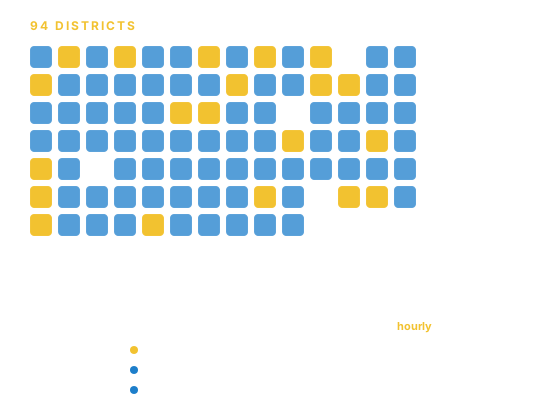
- 94 districts.
- Business cases only.
- Events typically within the hour of the court feed.
- Sector and size next day.
- Public sample delayed 30 days.
- Quiet courts with no RSS do not hit the national event list until a case is opened.
- MCP requires a subscription.
- No model writes the public tables.
What you can see
Dockets, documents, claims registers, and classified events, from nearly every court
PACER stores the filing you already know to open. TrollerBk takes the court event feed and links each line to a case, a docket, and a type: sale motions, plans, disclosure statements, distributions, claim transfers. A 363 in Nevada and a disclosure statement in Delaware land on the same list.
- Business cases nationwide. Corporations, partnerships, and other non-individual debtors in Chapters 7, 11, 12, and 15, from nearly every district (see the coverage note below). Individuals are filtered out.
- Classified docket events. Full docket sheets with one-click refresh from the court. Events are tagged so a market-wide question has an answer: plans, amended plans, disclosure statements, 363 sale motions, bid procedures, claim transfers, schedules, final reports, distributions, 9019 compromises, and more. The whole corpus is reachable from the buyer’s AI assistant.
- Court PDFs. Any docket entry's document, pulled from the court and stored. The next desk does not have to find it on PACER.
- Claims registers and transfers. Creditor, amounts, secured and unsecured splits, status, and the underlying Form 410 PDFs. Who bought claims last week, with twelve years of history behind it.
- Case attributes. So you can screen by size and sector without opening the petition: asset and liability ranges, creditor counts, nature of business, court, judge, related and jointly administered cases, EIN.
The product is a custom report around that screen, delivered by email, spreadsheet, a feed into your systems, or an AI assistant. The subscriber portal is for sitting with a case: refresh the docket, pull documents, read the claims register.
Refresh cadence
- New filings and docket events: pulled from every court’s PACER feed around the clock, typically within the hour.
- Case attributes: petition data (including sector and size) is added the following day.
- Docket sheets: refreshed on demand by subscribers and on a schedule for monitored cases.
- Claims registers: refreshed on demand and synchronized from claims agents (Kroll, Stretto, Epiq, Verita, Omni) for the largest cases.
- Claims-trade report: a weekly nationwide compilation of recorded trades. Structured history searchable back to 2014. Docket notices of transfer typically hit the event feed within the hour.
- Public docket-event sample: a delayed table of three event types on /latest, refreshed hourly. Subscribers see every classified event the day it is filed.
What the alternative costs
A national bankruptcy corpus is not a weekend build.
A lot of software today can be replaced by a small team and a weekend. This cannot. The reason is not cleverness; the raw material is metered.
PACER, by the page
PACER charges $0.10 per page. Documents and case-specific reports (docket sheet, claims register, creditor list) are capped at $3.00 each. Name searches and reports that are not case-specific have no cap. There is no cross-case query to buy at any price. A screen across 500 cases is 500 separate lookups.
Illustration: one analyst screening 20 cases a day, opening a docket report and three documents each:
- 20 docket reports at roughly $0.80 each ≈ $16
- 60 documents at the $3.00 cap ≈ $180
- ≈ $196 per analyst per day, about $4,100 per month, before anyone reads a page
Illustrative only; actual PACER spend depends on page counts and how much your team re-opens. The $3.00 cap does not apply to search results. Fees are set by the judiciary; they rise to $0.12 per page on January 1, 2027.
Then the rest of the stack
Pulling pages is the easy part. To answer “which cases have a sale motion this week” you also need:
- ingestion from more than 90 courts' feeds, running every hour, forever
- entity resolution across joint cases, transfers, and conversions
- classification of millions of docket entries into events
- claims register parsing and claim-transfer tracking
- document storage, deduplication, and cost accounting
- the AI usage to read and summarize what you pulled, at scale
- someone on call when a court changes its format
TrollerBk has built and maintained this since 2005 and spreads the cost across every subscriber. At the volume in the illustration, the PACER bill alone is already in the same range as a subscription, before classification, claims, and refresh.
Methodology and provenance
Where the data comes from and how the numbers above are counted
Sources
Primary sources are the United States Bankruptcy Courts' CM/ECF systems via PACER and the courts' public RSS feeds, supplemented by the public claims registers published by court-appointed claims agents. Background on federal court records is at uscourts.gov/court-records. TrollerBk adds classification, entity resolution, enrichment, and the cross-case index. Original court documents are always one click away from any derived field.
Business cases
Cases whose debtor is not an individual. Systematic coverage begins in 2005; a small number of older cases exist in the database and are excluded from the “years of history” figure so it is not overstated.
Which courts
The 94 US bankruptcy districts are in the corpus. You can open a docket in any of them. A few less-active courts do not publish an event feed we can pull, so their filings do not appear on the national docket-event lists until someone opens the case. If a specific court matters to your mandate, ask us and we will tell you exactly what we hold for it.
Counts
Docket entries, proofs of claim, and claim transfers are row counts from the production database, recomputed daily and rounded down for display. Courts are the active US bankruptcy courts we pull from. Filings arrive throughout the day; the “as of” date under the band is when the counts were last computed.
Limits
TrollerBk is a research tool, not a substitute for the court record. Docket text is the court's own language; case attributes are compiled from filings and may lag amendments. Nothing on this site is legal or investment advice.
Show this page to the person who approves the budget.
We will run your mandate against the last 30 days of filings so the first conversation is about real cases.